
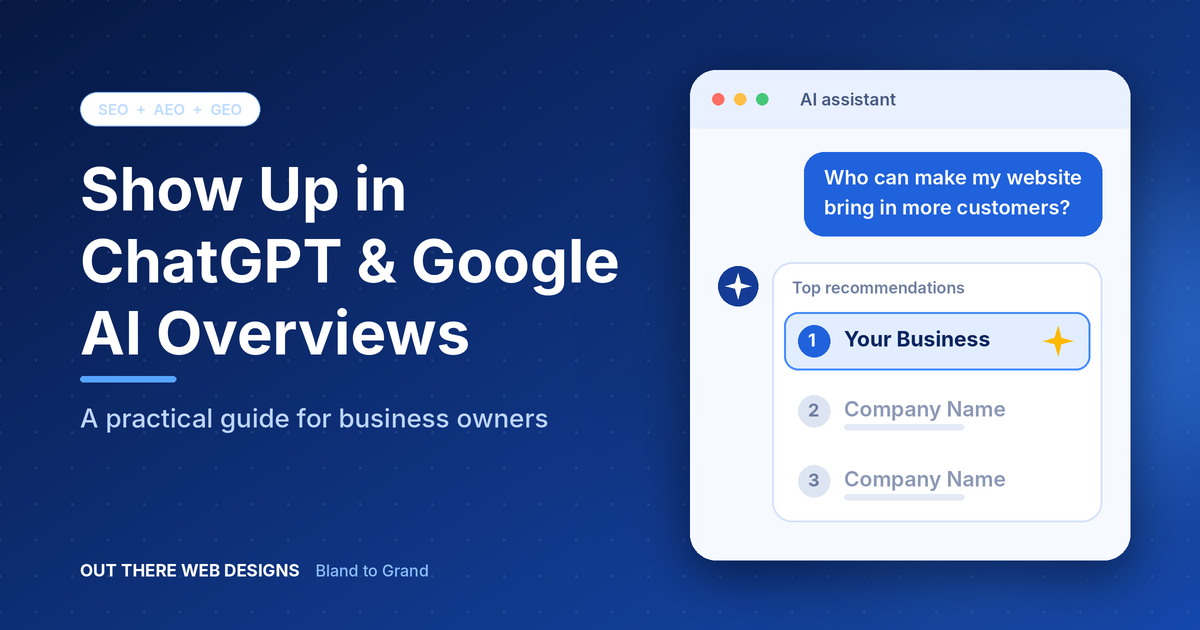
More people are asking ChatGPT, Gemini, and Claude for recommendations instead of scrolling through search results. Ask “who’s the best web designer near me” or “who can fix my website,” and the answer comes back as a short list of names. If your business isn’t on that list, the customer may never see you at all.
The good news is that AI assistants don’t pick businesses at random, and there’s no mystery about what influences them. Here’s how it works and what you can do about it.
SEO, AEO, and GEO in One Minute
- SEO (Search Engine Optimization) improves where your website ranks in traditional search results.
- AEO (Answer Engine Optimization) aims to get your business featured in the AI Overviews that appear at the top of Google results.
- GEO (Generative Engine Optimization) aims to get your business recommended when someone asks an AI platform like ChatGPT a question directly.
They overlap more than most people expect, and they all start from the same foundation.
What AI Assistants Actually Recommend
When you review how AI assistants answer customer questions about local services, a pattern shows up quickly. The assistants aren’t judging who is best. They’re summarizing what the web says about who is best. In practice, they lean on three kinds of sources:
- Directory and “best of” lists. For local and comparison questions, the same handful of review sites and ranking lists get cited again and again.
- Pages written to match the exact question. A page titled and written around “who can finish my unfinished app” beats a general services page that mentions it in passing.
- Educational guides. For “how do I” questions, the assistants often cite thorough, plain-English guides rather than company homepages.
That tells you where to put your effort.
There Is No Special Switch
As far as we can tell, there’s no form to submit your business to ChatGPT and no way to pay for placement in its answers. Google’s own documentation on AI features in Search also frames them as built on the same search fundamentals that already matter. The work is mostly about being easy to find, easy to understand, and easy to trust.
What Actually Moves the Needle
1. Make sure crawlers can reach your site
This is the one most businesses never check. Security tools, bot-protection settings, and verification screens can quietly keep automated visitors out, including the search engines and AI tools you want reading your pages. If they can’t read your site, nothing else you do matters. Test it before you invest in anything else.
2. Answer the question directly, at the top of the page
AI assistants quote pages that state a clear answer in the first sentence or two. Write each page around a real question a customer asks, answer it right away, then explain.
3. Show up on the lists the AI reads
If the assistants keep citing the same directories and ranking lists, those are the places to be listed. Complete your profiles, keep them accurate, and ask real customers for reviews.
4. Keep your business facts consistent everywhere
Your name, location, phone number, and services should match across your website, Google Business Profile, and every directory. Mismatches make it harder for an AI to be confident about who you are.
5. Add FAQ content with structured data
Question-and-answer sections, marked up properly, match how people ask assistants for help. Make sure each answer makes sense on its own.
6. Build proof people can verify
Many rankings online are self-published, and some AI answers even tell readers to check references before hiring anyone. Real reviews, named testimonials, and case studies with actual results give both the assistants and your prospects something to trust.
7. Measure it, then measure it again
Pick a set of real customer questions, record who gets recommended, and recheck on a schedule. One result doesn’t tell you much. A trend does.
What to Expect
This isn’t a one-week project. Directory listings and reviews take time to accumulate, new pages take time to be discovered, and AI answers change. The businesses that start now and keep checking will have a head start on the ones that wait until it’s obvious.
Frequently Asked Questions
What is the difference between AEO and GEO?
AEO focuses on appearing in the AI Overviews shown in Google search results. GEO focuses on being recommended inside AI platforms like ChatGPT, Gemini, and Claude. Both depend on strong fundamentals: a crawlable site, clear answers, and trustworthy third-party mentions.
Can I pay to be recommended by ChatGPT?
As far as we know, there’s no paid placement or submission form for recommendations in ChatGPT’s answers. Visibility comes from what’s published about your business across the web.
Do I still need traditional SEO?
Yes. AI features draw on the same search fundamentals, so good SEO supports AEO and GEO rather than competing with them.
How can I tell if AI assistants recommend my business?
Ask them the questions your customers ask, without naming your company, and note who comes up. Repeat on a schedule so you can see whether you’re improving.
How long does it take to show up in AI answers?
It depends on your starting point. Fixing crawl problems and publishing question-matched pages can show results sooner. Directory placements and reviews build more slowly.
Want to Know Where You Stand?
Start by finding out whether search engines and AI tools can read your site at all. Our free website teardown covers it. If you’d like help building visibility across Google, AI Overviews, and AI assistants, see our SEO, AEO, and GEO program, or get in touch.